
The Combination Tricast Explained – Cost, Settlement, and Practical Use
 Available in US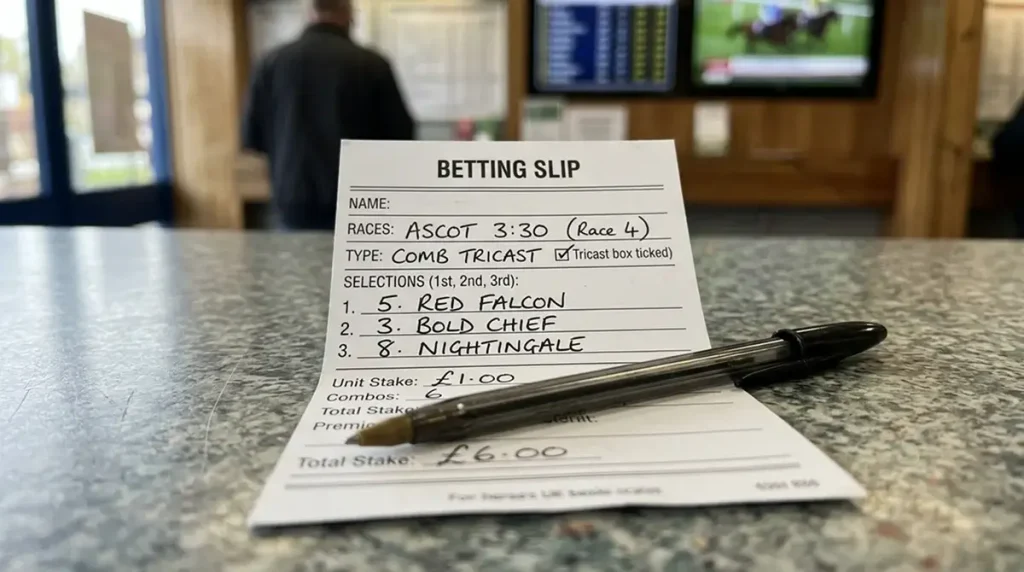
html
Contents
Six lines instead of one – and the moment you understand why
A reader of mine sent in a Tricast slip a couple of seasons ago that he was furious about. He’d backed three horses and they’d run first, second, and third in his exact picked order – and the bet hadn’t won. Because he’d placed a straight Tricast, with a fixed order, and the runners had finished in a different sequence to the one he’d written down. The horses finished 1-2-3 by name. The slip lost. He didn’t know there was such a thing as a combination Tricast.
The combination Tricast is the answer to that exact mistake. Same three horses, six possible orderings, all six covered by a single slip with stake multiplied by six. If any of the six finishing orders comes in, you win – at the specific price for that sequence. The structural appeal is obvious. The structural cost is also obvious. Six times the stake of a straight Tricast on the same selections. Whether the trade-off is worth it depends entirely on how confident you are in the order versus how confident you are merely in the names.
This piece walks through what the combination Tricast covers, what it costs, how it’s settled when runners are withdrawn, and where it earns its place against the straight Tricast and the Tote Trifecta box.
What the combination Tricast covers
Three horses, six possible finishing orders. A-B-C, A-C-B, B-A-C, B-C-A, C-A-B, C-B-A. The combination Tricast bundles all six into a single bet. The bookmaker prices each ordering independently – typically using the same Computer Straight Forecast extension that produces straight Tricast prices – and your slip pays out at whichever ordering matches the actual result.
This matters because Tricast pricing is not symmetric across orderings. The expected ordering – favourite first, second favourite second, third favourite third – carries the shortest price. The reverse ordering – outsider first, favourite third – carries by far the longest price. A combination Tricast on three runners covers every permutation, so the dividend on a “wrong-looking” finish where the longshot springs first can run dramatically higher than the dividend on the “right-looking” finish where the market got it broadly correct. The same architecture that produces fixed-odds Tricast prices in the first place – pricing implied second and third probabilities from advertised win odds with operator overround – means each of the six orderings has its own quoted return.
The fixed-odds Tricast requires 8 declared and 6 starters before the bet is offered at all. The combination version applies the same minimum-runner threshold, but it remains an unusual cousin of the straight bet rather than a different product class.
The cost table
Stake structure is the first thing to internalise. A £1 straight Tricast costs £1. A £1 combination Tricast on the same three horses costs £6, because each of the six orderings is itself a separate £1 line. Increase the unit and the cost scales linearly. A £2 combination Tricast on three horses costs £12. A £5 combination costs £30. There is no discount for multi-line placement, no rebate for unused permutations – the slip is mathematically equivalent to six individual straight Tricasts placed simultaneously, and the bookmaker treats it that way.
The settlement model is also linear. Only one of the six lines can ever win, so only one of the six unit stakes returns a dividend. The other five are lost. The bet’s expected return is therefore the sum of (probability of each ordering) multiplied by (advertised price of that ordering minus stake), summed across all six. In practice the combination Tricast is profitable to take when at least one of the six orderings is priced above its true probability – which happens often on bookmaker books with conservative overrounds on extreme orderings.
The pricing asymmetry across orderings is where the combination earns its keep. Bookmakers price the obvious orderings tightly because that’s where public money goes. The exotic orderings – outsider first, favourite back – are priced more generously because few punters back them and the book can afford to be loose. A combination Tricast captures every ordering, including the generously priced ones, in a single line.
Settlement rules and Rule 4 cases
Settlement on a combination Tricast follows the same withdrawal rules as the straight Tricast. If any of your three selected horses is withdrawn before the off and Rule 4 deductions apply, all six lines are adjusted. The deduction is applied per the BHA tariff against the price of the line that wins. If two of the three selected horses are withdrawn, the combination collapses – typically refunded in full, depending on the operator’s specific terms – because the bet was placed across three runners and the field has materially changed.
Non-runners during the race itself, such as a horse pulled up, refused at a fence, or unseated, are treated as having lost. The remaining horses’ positions are unaffected – the bet pays out only if the actual 1-2-3 across the line matches one of your six combinations. Tote Trifecta non-runner rules differ from fixed-odds Tricast non-runner rules in a way that catches out new punters; what looks like the same bet at the two windows is governed by separate settlement architectures.
The 25% pool deduction that applies to UK Tote Trifecta pools doesn’t enter the combination Tricast calculation at all – fixed-odds Tricasts are settled at the agreed price, not from a pool. The bookmaker’s overround does the same job, structurally, but the deduction is invisible to the punter and applied at the pricing stage rather than the settlement stage.
When the combination Tricast beats the straight Tricast and when it doesn’t
The combination earns its six-times-stake cost when your conviction is about the three horses but not about the order. If you genuinely don’t know which of A, B, and C will finish first, taking a straight Tricast on a guessed order means picking a price that may or may not match the actual ordering – and the price gap between the right and wrong orderings can be enormous. The combination flattens that risk by covering every permutation.
It doesn’t earn its keep when you have a clear view on the running order. If A is the obvious favourite, B is a logical second, and C is the value third placing, a straight Tricast in that specific order captures the precise dividend the bookmaker has priced for that combination – at a sixth of the cost of the combination. The straight Tricast is the disciplined version of the same opinion. The combination is the hedged version.
I tend to combine for one specific shape – three roughly evenly matched runners on heavy ground, where the order will be decided by a furlong of luck and there’s no defensible reason to prefer one sequence over another. On well-mapped pace shapes where one runner is the obvious leader and another is the obvious closer, I take the straight Tricast in the predicted order and accept the variance. The combination is a tool for genuine ordering uncertainty, not for general hedging – and for the structural alternative of building Trifecta tickets around a banker with combinatorial structure, the breakdown of box and key-banker construction for the UK Trifecta covers the pool-side equivalent in detail.
Choosing the right tool for the order question
The combination Tricast is one of those products that looks unnecessary until the moment you need it. Most weeks I don’t place one. But the times I do, it’s because the race genuinely defies ordering – three horses with similar form, similar weights, similar profiles, where any of the six permutations is plausible and the bookmaker’s price asymmetry across those permutations means the combination captures genuine value the straight bet would miss. Treat it as a specialist tool, not a default, and the six-times-stake cost stops looking like waste and starts looking like exactly the right insurance for exactly the right race.
