
UK Trifecta Bet in Horse Racing: The Complete Analyst's Guide for 2026
 Available in US
The gap is roughly twenty-six per cent. That is the average margin by which the UK Tote Trifecta has outpaid the bookmaker Tricast across 1,011 British and Irish handicaps in the most thorough study anyone has done on the question. I have spent twelve years modelling pool dynamics and forecast settlement, and that single number — twenty-six — is the reason I treat the Trifecta as the centre of any serious exotic strategy on this island. Not the Lucky 15. Not the Yankee. The Trifecta.
Most punters never see the gap because they never compare. They walk into a high-street shop, write a Tricast slip for the 3.40, hand it over, and never check what the same three runners returned on the Tote three rooms away. I have done that work for over a decade, and the pattern is consistent enough to bet a career on. When the Trifecta wins, it wins by an average of fifty-nine per cent. When the Tricast wins, it wins by fifty-two. That sounds even. It is not. The Trifecta wins four times in five.
What follows is a single long argument structured as a reference. I will walk through the mechanics on the UK Tote first, then the parallel Tricast market, then the dividend maths, then the staking formats, then the strategy. Around those mechanics I will plant the regulatory weather that the sport is currently flying through — affordability checks introduced in February, the Remote Gaming Duty rise coming on 1 April, the black market that has scaled by 522 per cent in three years. None of that is decoration. All of it changes how a thinking punter sizes a Trifecta in 2026.
A note on terminology. A Tricast is a fixed-odds bookmaker bet on the 1-2-3 in a qualifying handicap. A Trifecta is a pool bet on the same outcome, settled by the Tote after deductions. They look identical on the surface. The maths underneath is completely different. By the end of this guide you will know exactly why the pool wins more often, when it does not, and what the cost of being wrong is on a £1 unit. The remote betting GGY on UK horse racing was £766.7m in the year to March 2025 — and the slice of that money that flows through Trifecta and Tricast products is where the smartest UK staking lives.
The Twenty-Six Per Cent Edge at a Glance
- The UK Tote Trifecta has outpaid the bookmaker Tricast in roughly eighty per cent of qualifying handicaps, with an average advantage of twenty-six per cent.
- Tote pool takeout is twenty-five per cent. Minimum unit is ten pence, minimum bet placement is £2.
- The biggest UK Trifecta on record paid £122,667.10 to a £1 unit on the 2024 Coventry Stakes, against £83,273.26 for the Tricast on the same race.
- Affordability checks trigger at £150 in monthly net deposits from February 2025. Remote Gaming Duty rises from twenty-one to forty per cent on 1 April 2026.
- Play Premier fixtures, festivals and World Pool days where pool depth and Tote+ enhancement put the structural edge at its widest.
How the Trifecta Works on the UK Tote
I once watched a punter at Newbury tear up a winning slip because the dividend looked too small. He had backed a Trifecta on a six-runner novice flat race with an odds-on favourite and a painfully predictable 1-2-3. The dividend paid £14.20 to a £1 unit. He wanted a hundred. The maths he was missing is what this section is for.
A UK Trifecta is a Tote-operated pool bet. You select three horses to finish first, second and third in exact order. Every stake placed on the race — through every channel — is collected into one pool. The Tote removes its statutory deduction. What is left is divided among the winning unit stakes.
The Tote takeout, in one line. The UK Tote applies a pool deduction of twenty-five per cent on Trifecta stakes. For every £100 that enters the pool, £75 is returned to winning tickets. The Irish equivalent is thirty per cent — one reason UK Trifecta dividends average roughly twenty-four per cent higher than Irish dividends on comparable handicaps.
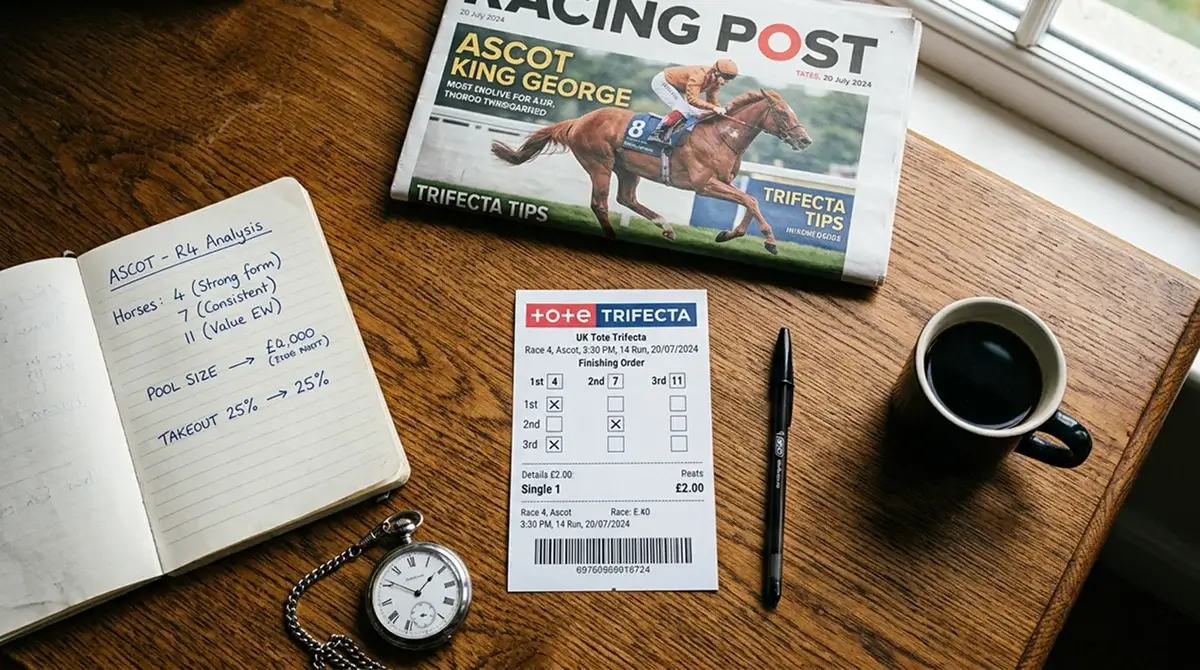
The minimum unit is ten pence. The minimum bet placement is £2. A 10p unit lets you build large combinatorial slips without scaling stake in lockstep with risk. A Trifecta box of four runners costs £2.40 at the 10p unit, which is below the placement floor, so you stake at least £2 in unit terms or accept the £2 minimum as a single straight bet.
What gets paid and what does not
The Tote publishes a dividend to the £1 unit. If the published figure is £142.80, a 10p unit pays £14.28. A £5 unit pays £714. The dividend already includes the deduction — it is calculated on the net pool, not the gross stake. You do not subtract anything from the published figure. You scale it.
If a horse is declared a non-runner, your selection is replaced or refunded under standard Tote rules — typically a full refund where a named runner is withdrawn. There is no Rule 4 deduction on the Tote in the way there is on a fixed-odds Tricast.
Pari-mutuel — pool betting, from the French for "mutual stake". All stakes go into one pot, the operator removes a fixed percentage as takeout, and the rest is divided among winners. The UK Tote is a pari-mutuel operator. Bookmakers running fixed-odds Tricasts are not.
The other thing the Tote does that bookmakers cannot is share liquidity. When a UK fixture is part of the World Pool — a partnership with the Hong Kong Jockey Club — your Trifecta stake joins a global pool that ran to more than £541m across seventeen UK and Irish World Pool fixtures in 2022. Deeper pools produce smoother dividends and less variance at the long end.
Mechanics is the price of entry. The interesting question is what the Trifecta is worth relative to the alternative — and on the same race, the alternative is the Tricast.
Trifecta vs Tricast: The UK's Two Parallel Markets
Here is a question I have asked a hundred trainee handicappers without a confident answer. If the Trifecta and the Tricast take the same three horses in the same order, and one pays £23,748.90 while the other pays £73,711.25, which did the bettor take? The 2019 Cheltenham race I am thinking of paid the Computer Tricast more than three times what the Tote Trifecta paid. Anyone telling you the Tote always wins is selling something.
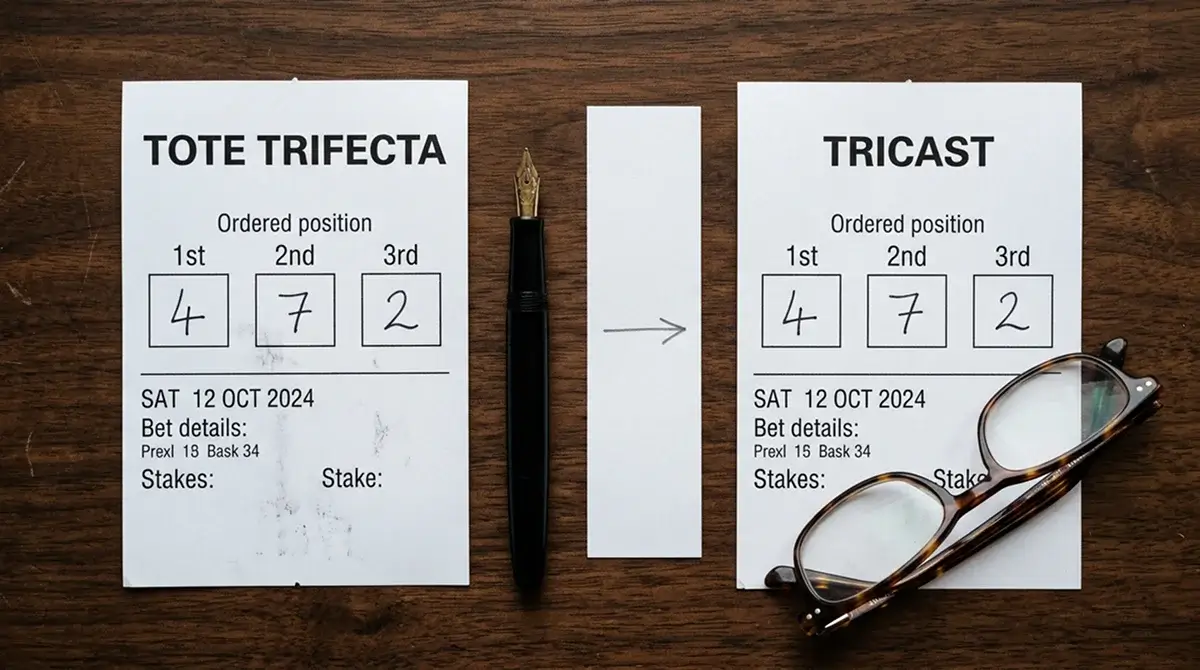
A Trifecta is pool. A Tricast is fixed-odds, computed by a formula. The Computer Straight Forecast — the CSF — is the bookmaker industry's algorithm for forecast and tricast prices on qualifying handicaps. It takes the SPs of the placed runners and runs them through a published formula to produce a settled dividend. The bookmaker's overround is baked into the SPs themselves.
| Feature | Tote Trifecta | Bookmaker Tricast |
|---|---|---|
| Mechanism | Pari-mutuel pool | Fixed-odds via CSF formula |
| Deduction | Twenty-five per cent pool takeout | Built into SPs and the formula |
| Minimum unit | Ten pence | Varies by operator, typically 10p–25p |
| Field-size requirement | Selected qualifying handicaps and festival races | Handicap with eight declared and six actual starters |
| Non-runner treatment | Refund or substitution under Tote rules | Rule 4 deductions applied where relevant |
| Average UK payout advantage | Higher in roughly four cases out of five | Higher in the remaining cases, often dramatically |
| Best for | Longshot 1-2-3, festival pools, big-field handicaps | Short-priced favourites where the pool is thin |
The David Renham study on Geegeez covered 1,011 UK and Irish handicaps — the most rigorous public comparison anyone has produced. Eighty per cent of the time the Trifecta paid more than the Tricast. When the Trifecta won, it won by an average of fifty-nine per cent. When the Tricast won, by fifty-two. Net of that, the Trifecta outperformed by roughly twenty-six per cent across the sample. That is a structural edge, not a guarantee on any individual race.
I have a deeper breakdown in the dedicated Trifecta vs Tricast payout comparison. The headline to anchor everything else is that twenty-six.
The Trifecta wins the payout comparison four times in five. The Tricast wins the remaining one in five — and when it wins, it can win big. The point of analysis is not to pick a side. It is to know which product fits which race.
When the Tricast wins
The Tricast tends to win when the favourite or co-favourite is in the 1-2-3 and the pool was thin to begin with. The CSF formula does not care how much money is in any pool, because there is no pool. The 2025 Grand National was a clean version: Willie Mullins took the first three with Nick Rockett, I Am Maximus and Grangeclare West, and an £8 each-way Tricast paid out more than £61,000 because the SPs included a 33/1 winner.
The Trifecta tends to win when there is at least one genuine longshot in the frame and the field is big enough to dilute the public's instinct. The 2024 Coventry Stakes at Royal Ascot returned a Trifecta of £122,667.10 to a £1 unit on an 80/1, 40/1, 50/1 finish. The Tricast on the same race paid £83,273.26 — forty-seven per cent less. Three longshots, deep pool, and the pari-mutuel mathematics produced a record. That is the Trifecta's home ground.
The 2025 Betting Market in Numbers
I keep a small printed sheet on my desk with the British racing market's vital signs updated quarterly. It tells me, at a glance, whether the river the Trifecta sits in is rising or falling. In 2025 it has been falling, and that matters more than most casual punters realise. Pool size, field size, fixture allocation — they all flow through to dividend stability. So before any strategy talk, the numbers.
£766.7m
Remote betting GGY on British horse racing in the year to March 2025 — second behind football's £1.3 billion in the £2.6 billion total remote betting market.
£109m
Levy yield for the twelve months to 31 March 2025 — the fourth consecutive annual increase and the highest figure since the 2017 collection reforms.
8.43
Average field size across British racing in the first half of 2025. The second-lowest reading since 1995. Jumps averaged 7.83, Flat 8.83.
4.2%
Drop in total betting turnover by the end of Q3 2025 compared with the same nine-month period in 2024 — and 12.8 per cent below the equivalent stretch of 2023.
Read those four numbers as a single sentence and the story comes out clearly. The product is still vast — three-quarters of a billion pounds in remote-betting GGY is not a small market. The sport is still well-funded — £109m in Levy is a record under the post-2017 regime. But turnover is contracting, and the races themselves are getting smaller. Average turnover per race has fallen by 5.8 per cent against 2024 and by 11.4 per cent against 2023. Field sizes are below the long-run average, with seventy-eight per cent of fixtures in the first three months of 2025 raced on soft or heavy ground against a three-year average of forty-eight per cent. Wetter going. Smaller fields. Less turnover. Thinner pools.
Q1 2025 turnover on British racing was down nine per cent on Q1 2024. The drop was concentrated in Core fixtures, which fell by 14.4 per cent, while Premier fixtures held flat. That split is the most important fact about modern UK racing economics. Money is consolidating into the Saturdays, the festivals, the marketed days. Midweek meetings — the bread-and-butter of handicap pools — are bleeding turnover faster than the sport on aggregate.
£153m
Total prize money in British racing rose by £4.7m to £153m in 2025. Grassroots prize money, however, fell by £3.6m. The growth is real and the redistribution is real. Premier fixtures are the centre of gravity now.
For a Trifecta player this is not abstract. Field size is the first input into pool depth. A handicap with twelve runners produces a vastly bigger pool than the same handicap reduced to seven by non-runners. Premier fixture concentration means the days when a Trifecta is genuinely worth playing are now bunched into specific dates. Every one of the twenty-eight races at the 2025 Cheltenham Festival finished in the top thirty-one British race meetings by betting turnover for the year. That is concentration. The potential of UK racing is real; the current shape of the market means that potential lives in a handful of days a year.
The Anatomy of a Trifecta Dividend
Most punters check the dividend and never check the maths behind it. They see £142.80 to a £1 unit and either celebrate or curse. Neither response is analytical. The published dividend is the end of a sequence of operations, and every one of those operations tells you something about whether you got value or got lucky.
Stage 1: The gross pool. Assume a UK handicap collects £40,000 in Trifecta stakes across all channels. That is the gross pool.
Stage 2: The takeout. The Tote deducts twenty-five per cent. Net pool: £30,000.
Stage 3: Winning units. Suppose 1,000 winning ten-pence units hold the correct 1-2-3. Converted to £1-unit equivalents: 100 winning units.
Stage 4: Per-unit dividend. £30,000 divided by 100 = £300. Published dividend to a £1 unit: £300. A 10p unit returns £30.
Stage 5: Your payout. Holding one 10p unit, you collect £30. Holding a £6 box of three horses with one winning combination, you collect £300 less your £5 in losing stakes — net £295.
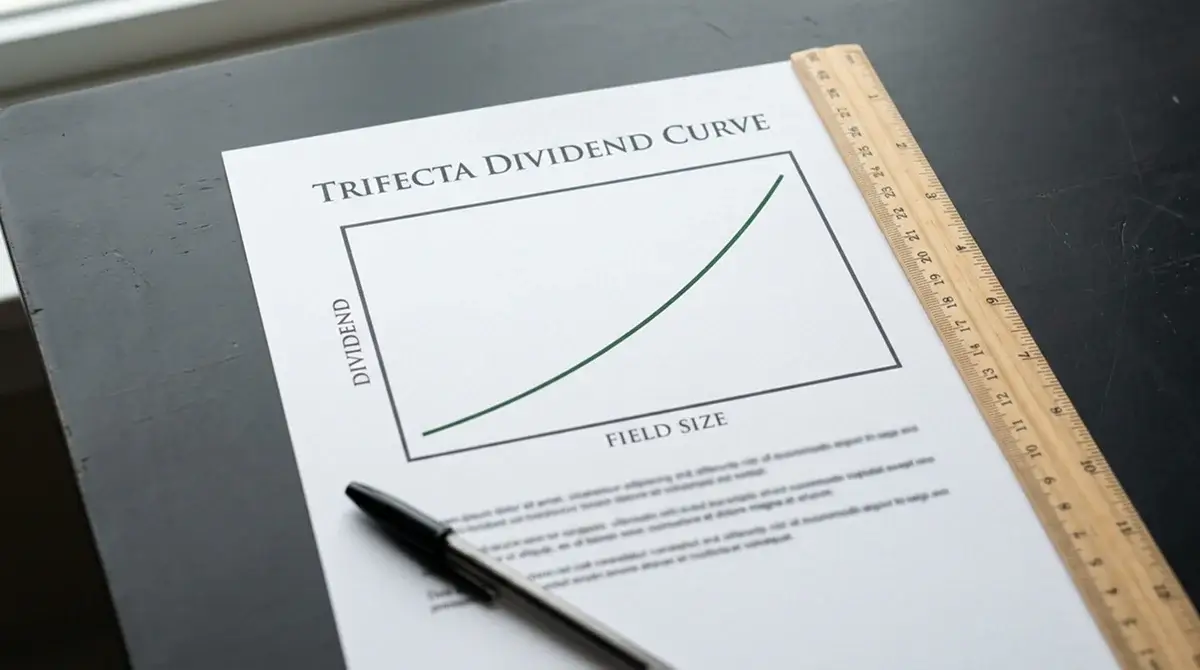
Five stages, no mystery. The structure is constant. The shape of the curve changes when the pool is bigger or smaller, when winning combinations are concentrated or dispersed, and when the favourite is or is not in the frame.
Look at the extremes. The 2024 Coventry Stakes Trifecta of £122,667.10 to a £1 unit works backwards from net pool divided by £1-equivalent winning units. The 80/1, 40/1, 50/1 finish concentrated value into a handful of ticket-holders. That is what produces a record — not the size of the pool, but the dilution of the winning side.
| Horse | Position | SP |
|---|---|---|
| Coventry winner | 1st | 80/1 |
| Coventry second | 2nd | 40/1 |
| Coventry third | 3rd | 50/1 |
Trifecta dividend to £1 unit: £122,667.10. Tricast on the same race: £83,273.26.
A 2019 Cheltenham handicap paid a Tricast of £73,711.25 against a Trifecta of £23,748.90 — 50/1, 66/1, 40/1 finishers, and yet the Tricast won by more than three to one. On small-pool handicaps where the favourite did not figure but the field was modest, the CSF multiplication can outpace the pool's dilution.
If you want the full mechanics of payout computation, including how 10p units interact with the published £1 dividend and how net pool size translates into per-unit returns, I have built a dedicated UK Trifecta payout calculator guide that walks through each step with worked numbers.
Knowing the anatomy of a dividend is one thing. Knowing when the Tote's own enhancement programme bends that anatomy in your favour is another — and on qualifying races the bend is substantial.
The Tote+ Edge and World Pool Liquidity
A friend who has been writing about racing longer than I have been alive once told me the UK Tote spent twenty years being the most under-appreciated edge in British betting. The introduction of Tote+ and the partnership with the Hong Kong Jockey Club on the World Pool changed that. The Tote is no longer the cautious old institution. It is now the structural counter-party I look at first on any qualifying race.
Tote+ in three numbers. Tote+ Trifecta outperforms the bookmaker Tricast in seventy-seven per cent of qualifying cases, providing on average fifty per cent more value per bet. Before Tote+, the Tote dividend beat the Starting Price in thirty per cent of cases. With Tote+, that figure rose to fifty-four per cent. The Tote+ Exacta beats the Computer Straight Forecast in seventy-seven per cent of cases, with an average uplift of twenty-one per cent.
Those are independent comparisons of Tote+ enhanced dividends against bookmaker settlement prices on the same races. The mechanism: Tote+ tops up the standard Tote dividend on selected races so the published return is at least the SP-equivalent value plus a margin. The Tote absorbs the difference. That converts what used to be an edge-of-the-distribution argument into a base-rate one.
World Pool sits behind that. In 2022, seventeen World Pool days on UK and Irish fixtures attracted more than £541m in stakes — pool depth no bookmaker book can match. Bigger pools produce smoother dividend distributions and less variance at the long end, making the Trifecta viable on races where it would otherwise be too thinly contested.
The World Pool effect is most visible at Royal Ascot, where Trifecta dividends on World Pool days run two to three times what the same fixture would produce on a non-pool day. Deeper pool means more total prize money in the net pot, and the international stakes do not cluster identically on the same combinations as the UK retail money.
I cover Tote+ mechanics and the World Pool calendar in detail in the dedicated Tote+ and World Pool guide. The headline is that the structural edge of the Trifecta over the Tricast is widest on Tote+ races and World Pool days, narrowest on small-field core-fixture handicaps.
Straight, Box, Banker and Permed Trifectas
The first Trifecta I lost on purpose was a £2 straight at Ayr. I had three runners in exact order; two obliged, the third I had as second when it ran third. The dividend on the actual 1-2-3 was £640 to a £1. My selection paid nothing. Order matters as much as the names. Your staking format is how you trade off cost against the discipline of order.
The straight Trifecta
Three horses, one specific order. Cost equals your unit stake. The highest-conviction, lowest-cost format and the one I use most on Tote+ races where I have a clear read on the full 1-2-3 sequence.
The box Trifecta
You select three or more horses and cover every order in which they could finish 1-2-3. Combinations follow n × (n−1) × (n−2).
Cost of a £1 box Trifecta by selections.
3 horses, 6 combinations: £6.
4 horses, 24 combinations: £24.
5 horses, 60 combinations: £60.
6 horses, 120 combinations: £120.
7 horses, 210 combinations: £210.
At a 10p unit, divide each figure by ten. A 10p box of six runners costs £12.
The cost curve is brutal. Adding a sixth horse triples your stake against a five-horse box. Most punters discover this the wrong way round and find themselves committed to £120 on a race they only liked at £30 of risk. Discipline on box size is what separates Trifecta players who last from those who do not.
The banker Trifecta
A banker Trifecta pins one horse to a fixed position — usually first — and permutates the rest. Key a banker to win, pick three others for second and third: six combinations, cost is 6 × unit. The right tool when conviction on the winner is very high but conviction on the placed horses is moderate.
Do
- Use the banker when one horse is materially the strongest on your handicapping.
- Apply it to a clear front-runner in a paceless field.
- Restrict supporting selections to no more than four to contain cost.
Do not
- Banker the favourite simply because it is the favourite.
- Over-perm the supporting horses — every selection multiplies the stake.
- Use a banker on a true open handicap with no obvious class horse.
The permed Trifecta
Permed Trifectas extend the banker logic. Nominate two bankers and perm the remaining slot, or take one banker and a wider pool for the other two positions. A four-horse perm with one banker for first and three for the remaining two slots is 1 × 3 × 2 = 6 combinations. The same with five horses behind is 1 × 5 × 4 = 20.
I cover staking architectures and the strategic case for each format in the dedicated Trifecta box, key and banker strategy guide. Format selection should follow your conviction shape, not the other way round.
Strategy Foundations: Field, Pace, Class
Ask a hundred handicappers what wins a Trifecta and you will get a hundred answers wrapped around three real ones: field, pace, class. Everything else is decoration. I have built spreadsheets, regression models, draw-bias matrices, and every one of them comes back to the same trinity. Field size sets the variance. Pace sets the shape. Class sets the floor.
Field
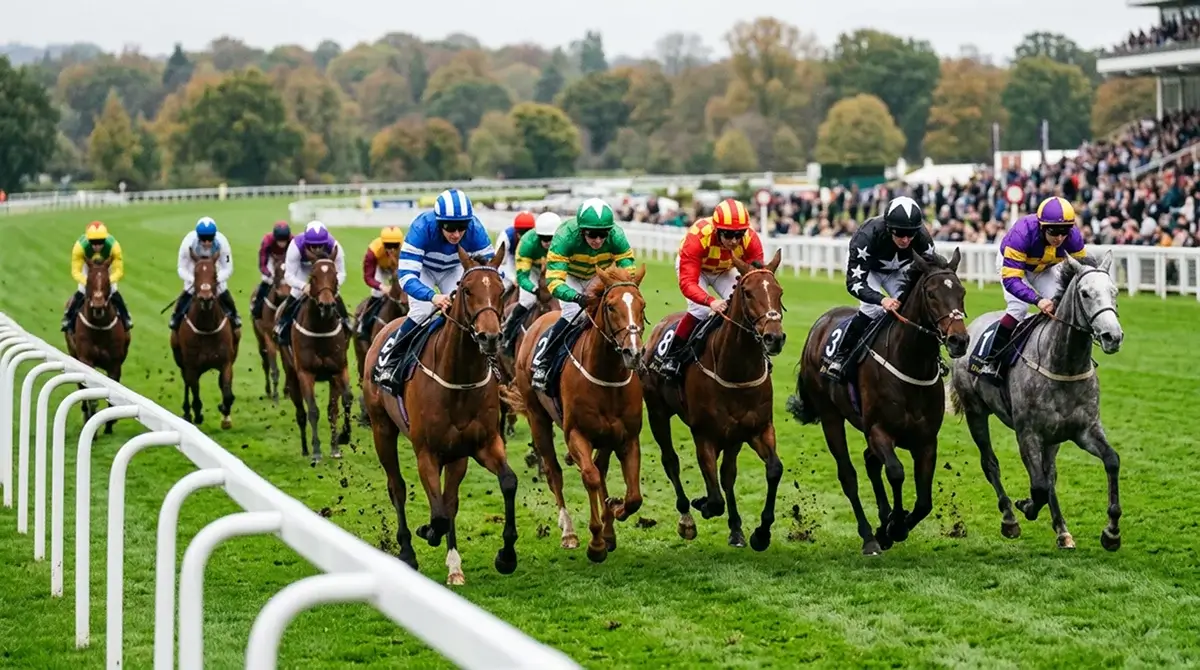
The mathematical reality of Trifecta value lives in field size. A six-runner handicap has 120 possible 1-2-3 outcomes. A twelve-runner handicap has 1,320. A sixteen-runner handicap has 3,360. The pool size does not grow at the same rate, so bigger fields produce more dispersed pools and the kind of dividends that make the bet worth playing.
The 2025 data is uncomfortable on this point. Average field size in the first half of the year was 8.43 — the second lowest reading since 1995. Jumps averaged 7.83. Flat averaged 8.83. The BHA's Q3 2025 report had Core Flat fixtures averaging 8.54 runners against 8.78 in 2024, and Core Jumps at 7.63 against 8.52 a year earlier. The days when fields are genuinely large — festivals, headline Saturdays, World Pool fixtures — are disproportionately valuable.
Pace
Pace is the most under-analysed input in Trifecta selection. In a speed-heavy race with multiple front-runners, the closers come into their own and the placed positions diversify. In a slow-paced race with one obvious front-runner unchallenged, the favourite often dictates and the 1-2-3 is orderly. Speed-heavy fields argue for wider boxes covering the closers. Slow-paced fields argue for bankers on the proven front-runner.
The 2025 going data complicates pace reads. Seventy-eight per cent of fixtures in the first three months of the year were raced on soft or heavy ground against a three-year average of forty-eight per cent. Soft and heavy ground compresses pace differentials and rewards stamina over speed.
Class
Class is the steadying input. Handicap ratings, official ratings, recent form figures — they define the floor of what a horse can do under given conditions. The 1-2-3 of a competitive handicap almost always includes at least one runner with consistent placed efforts. The Trifecta player who ignores class numbers in favour of price-driven hunches is essentially betting on randomness.
Pre-bet Trifecta checklist
- Confirm the race is a qualifying handicap or festival fixture eligible for the Trifecta pool.
- Check field size — eight declared runners is the practical floor, twelve plus is preferred.
- Read the pace map. Identify front-runners and closers before reading prices.
- Note the going. Verify selections have form on the prevailing ground.
- Match staking format to conviction shape.
- Calculate the box or perm cost before placing.
- Confirm whether the race is a World Pool or Tote+ fixture.
Field sets variance. Pace sets shape. Class sets the floor. The Trifecta you build is the answer to a three-variable question. Get one wrong and the staking format cannot save the slip.
Strategy lives inside a rule-set, and the rule-set is changing. The next section is the regulatory landscape that determines what you can stake, where, and under what scrutiny in 2026.
The 2025–2026 Regulatory Landscape
In February the affordability checks went live. In April the Remote Gaming Duty increase lands. In between, every UK Trifecta player has lived through a year of regulatory weather that has no precise precedent in British betting history. I sat down in February to update my own pre-bet documentation and ended up rewriting half of it.
What changed and when. The financial vulnerability check trigger went live at net deposits of £150 per month from February 2025. The Remote Gaming Duty rate rises from twenty-one per cent to forty per cent on 1 April 2026, applied to online casino. Horse racing's effective tax rate has stood at twenty-five per cent — General Betting Duty at fifteen per cent plus the Levy at ten — against the twenty-one per cent that applied to online casino before the April rise.
The affordability check matters to Trifecta players for a specific reason. The £150-a-month threshold is low enough to catch any serious recreational punter who plays festival cards. A single Saturday at Cheltenham across a box of seven races at modest stakes can carry a punter past the threshold in one afternoon. The check itself is not a prohibition — it is a request for documentation to demonstrate that the staked amount is proportionate to financial circumstances. Fifty-two per cent of respondents in a BHA-commissioned survey said they would reduce or stop betting under intrusive financial checks. The behavioural response is real, and it shows up in the turnover decline.
The Remote Gaming Duty rise is more complicated. The headline rate goes from twenty-one to forty per cent. RGD applies to online casino — slots, table games, the products that compete for the same wallets as racing without funding the sport through the Levy. The BHA's view, supported by independent modelling, is that a harmonised twenty-one per cent tax across betting and gaming would have cost UK racing approximately £66m a year and put 2,752 jobs at risk. The actual change preserves the differential — racing still operates at its existing tax structure while gaming faces a steep increase — but the dynamic effects on operator behaviour are not yet known.
The Levy in context. The Horserace Betting Levy is the statutory contribution from bookmakers' bet-receipt margins on British racing. Levy yield for the twelve months to 31 March 2025 reached almost £109m — the fourth consecutive annual increase. The Levy funds prize money, integrity services, and regulatory infrastructure. Bets on the Tote do not contribute to the Levy in the same way as bookmaker bets, though Tote proceeds flow into separate racing-funding mechanisms.
The interaction matters specifically for the Trifecta because the bet is exotic — it produces high variance in net deposit patterns. A bettor running a £50-a-week recreational habit on win-singles might never trigger the threshold, while the same bettor running £20 weekly on Trifecta perms might cross it on the first festival because perm staking inflates the deposit figure regardless of the recreational scale of the underlying intent.
The full breakdown of the 2025–26 regulatory framework is in the cluster article on UK Trifecta regulation 2025–2026. The point here is that the regulatory weather changes how you size your bets, how you record them, and where you hold them.
The Black Market Shadow Over UK Racing
Five hundred and twenty-two per cent. That is the growth in unique customers visiting twenty-two unlicensed gambling sites between August 2021 and September 2024, according to the International Federation of Horseracing Authorities. Across the same period, ten licensed sites grew their unique visitors by forty-nine per cent. The licensed market grew. The unlicensed market grew more than ten times faster.
522%
Growth in unique visitors to unlicensed UK gambling sites between August 2021 and September 2024. The licensed equivalent grew by 49 per cent.
The aggregate scale is the second number that has changed the conversation. Illegal gambling stakes from UK consumers reached an estimated £16.6 billion in 2025 — more than triple the £5 billion estimated for 2019. Frontier Economics, in research commissioned by the BGC, calculated that 1.5 million Britons stake up to £4.3 billion on the black market every year. Offshore gross gambling yield was £685m in 2025 against £200m in 2019.
For 2025's Grand National, the BGC estimated that approximately £10m would be staked illegally on the black market against the £250m expected through licensed channels — roughly 3.8 per cent of the total handle on one race. That ratio is small in percentage terms and very large in absolute terms. The unlicensed share is structural, and it is concentrated on exactly the events that produce the biggest legitimate Trifecta pools.
Grainne Hurst, the Chief Executive of the BGC, has been blunt about the direction. Her statement that a harmful black market is scaling up at pace, that illegal operators are becoming more sophisticated and aggressive in how they reach UK customers, and that this should concern anyone who cares about consumer protection, is a fair summary. Sophistication, visibility, aggression — three words describing a different operating environment from the one that existed at the start of the decade.
For a Trifecta player the practical implication is simple. Stay in the licensed market. The Tote Trifecta and the regulated bookmaker Tricast are the only two products with full consumer protection, integrity-checked race data, and recourse in the event of dispute. The price you pay for the regulated market is the affordability check and the takeout. The price you pay for the unlicensed market is everything else.
The Levy: Why Your Trifecta Funds the Sport
The reason British racing exists at the scale it does — fifty-nine licensed racecourses producing the fixtures that feed every Trifecta pool you have ever played — is a statutory mechanism that almost no recreational punter could explain. The Horserace Betting Levy is the financial spine of the sport.
£109m
Levy yield for the twelve months to 31 March 2025 — fourth successive annual increase, highest since the 2017 collection reforms.
£113m
Total HBLB income in 2024-25, up from £108.7m in 2023-24, lifting reserves to £58.7m.
£93m
HBLB commitment to prize money and integrity for 2025, with an additional £4.4m allocated for 2026 over 2025 levels.
£4.1bn
The annual direct, indirect and associated economic contribution of British racing to the UK economy, supporting more than 20,000 jobs across 59 licensed racecourses.
Alan Delmonte, HBLB's Chief Executive, confirmed the headline figure when the latest Annual Report was published: Levy yield for the twelve months to 31 March 2025 reached almost £109m — the fourth successive year of increase and the highest since the Levy collection reforms of 2017. Levy yield rose from £98m in 2021–22 to £100m in 2022–23, then to £105m in 2023–24, and now £109m. Four consecutive years of growth in a market where overall turnover has been falling. That growth has been driven by yield management — the percentage of betting margin captured for the sport — rather than by overall betting volume.
The Levy applies to bookmakers' bet receipts on British racing. It does not apply to the Tote pool in the same direct sense — Tote contributions to racing funding flow through separate mechanisms. The licensed market as a whole is the funding base for the sport. The unlicensed market contributes nothing.
The 2026 allocations matter for what they signal. HBLB has earmarked £4.4m of additional prize money for 2026 over 2025 levels, flowing preferentially to Premier fixtures. Cheltenham Festival 2025 prize money reached £4.93m and is expected to exceed £5m in 2026. The Premier-fixture concentration I described in the market section is reinforced by the Levy allocation pattern. The pools you can play with conviction are the pools at the fixtures the sport is funding most heavily.
The Levy is not just a tax — it is the calendar that tells you when to play.
The numbers tell you where the money flows. The voices in the next section tell you what the people moving that money are worried about — and on the Trifecta, the worries are pointed.
What the People Running British Racing Are Saying
I have spent a fair amount of the last twelve months listening to the people who run this sport — at BHA briefings, HBLB events, in the public statements coming out of the BGC. Three voices keep returning to my notes. They disagree productively, in a way that matters to anyone betting into the markets they oversee.
Brant Dunshea, the BHA's Chief Executive, has framed the strategic question this way: the biggest takeaway is that there is a vast, untapped market for the sport with significant potential for growth. He has also addressed the data demand directly, noting that there is an ever-growing desire for data among those consuming and betting on racing.
On regulation, Dunshea's position on the affordability-check argument is explicit: for every racing customer who leaves the legal market for the illegal one, the customer puts themselves at increased risk with reduced consumer rights and protections. That is the case for proportionate regulation and for staying in the licensed market.
From the BGC side, Grainne Hurst's statement that a harmful black market is scaling up at pace, that illegal operators are becoming more sophisticated and aggressive in how they reach UK customers, sets the urgency on the unlicensed side. The BGC's finding that almost £10m would be staked illegally on the 2025 Grand National against £250m through licensed channels is a clean illustration.
The Jockey Club's then-Chief Executive Nevin Truesdale takes a different angle: the Gambling Commission, in his view, seems to want to reduce gambling to just small-stakes gamblers, and the Commission's remit has slipped from facilitating safe gambling toward something closer to undermining it. The operators making the markets you bet into hold this view in significant numbers, and it shapes how they are pricing risk.
Richard Wayman, the BHA's Director of Racing, provides the steadying voice. His observation — that while the sport faces challenges it is important not to lose sight of how much pleasure racing continues to provide at all levels — is the right framing for the long view. The 4.8 million who attended UK racing events in 2022 did not disappear because of regulatory turbulence. The product is durable.
Frequently Asked Questions
What is a Trifecta bet in UK horse racing?
A Tote pool bet on a single race where you select three horses to finish first, second and third in exact order. The Tote applies a twenty-five per cent deduction to the gross pool and divides the net among winning unit stakes. The minimum unit is ten pence, the minimum bet placement is £2. The product runs on selected qualifying handicaps, festival races and World Pool fixtures — not every race.
What is the difference between a Trifecta and a Tricast in the UK?
The Trifecta is a pari-mutuel pool bet settled by the Tote after a twenty-five per cent deduction. The Tricast is a fixed-odds bookmaker bet priced via the Computer Straight Forecast formula on starting prices. Across 1,011 UK and Irish handicaps, the Tote Trifecta paid more than the Tricast in roughly eighty per cent of cases, with an average twenty-six per cent advantage. The Tricast outperforms on races with one longshot at the front and short-priced placed horses behind.
How does the cost of a Trifecta box scale with the number of horses?
Combinations follow n × (n−1) × (n−2): three horses produce 6 combinations, four produce 24, five produce 60, six produce 120, seven produce 210. At a £1 unit those numbers are also the cost in pounds; at a 10p unit, divide by ten. The cost curve is sharply convex — adding a sixth selection triples the stake against a five-horse box.
What is the minimum stake for a Trifecta on the UK Tote?
The minimum unit is ten pence; the minimum bet placement is £2. A 10p unit on a single straight does not meet the £2 floor, so punters either accept £2 as the minimum single stake or build a combinatorial slip — a box or perm — large enough that cumulative 10p units exceed £2.
On the long run, which bet has delivered larger UK dividends — Trifecta or Tricast?
The Trifecta has delivered larger dividends in roughly eighty per cent of qualifying handicaps, averaging a twenty-six per cent advantage. When the Trifecta beat the Tricast it did so by fifty-nine per cent on average; when the Tricast beat the Trifecta it did so by fifty-two per cent on average. Structural edge lies with the Trifecta; the Tricast retains an edge on specific race shapes.
What happens to my Trifecta if a horse becomes a non-runner?
On the UK Tote the affected unit is most commonly refunded under the product's rules — there is no Rule 4 deduction on the Tote. On the bookmaker Tricast, the withdrawn runner triggers Rule 4 adjustments to the SPs used by the CSF formula, which can materially reduce the eventual Tricast dividend.
What was the biggest Trifecta payout in UK racing history?
£122,667.10 to a £1 unit on the 2024 Coventry Stakes at Royal Ascot, on an 80/1, 40/1, 50/1 finish. The Tricast on the same race paid £83,273.26 — forty-seven per cent less. Other notable figures: more than £61,000 on an £8 each-way Tricast on the 2025 Grand National Mullins 1-2-3, and £73,711.25 on a 2019 Cheltenham Computer Tricast against £23,748.90 for the Trifecta.
The Analyst's Closing Brief
I started this guide with twenty-six per cent. The whole argument has been an unfolding of that number into context — the mechanics that produce it, the staking formats that exploit it, the regulatory weather that complicates it, the calendar of fixtures where it lives. If you take one thing away, take the calendar. Premier fixtures, festivals, World Pool days, big-field handicaps on Saturdays — these are the days the Trifecta exists to be played. The midweek six-runner novice is not your race.
Play the days the sport is funding. Match the staking format to the conviction shape, not the other way round. Track the dividend mechanics, not just the headline number. Stay in the licensed market. The Trifecta has a structural twenty-six per cent edge over the Tricast that does not exist on any other UK exotic.
The 2026 season opens with a regulatory environment unlike any in living memory, a Levy yield at a record £109m, average field sizes at the second-lowest level since 1995, and a Trifecta product that has rebuilt itself around Tote+ enhancement and World Pool depth. The bet is in better mathematical shape than at any point in the last decade. The market around it is changing fast. Treat the Trifecta the way a serious analyst treats a derivative — understand the underlying, model the variance, size the bet to the conviction. The pool will reward you in proportion to the discipline you bring to it.
