
Going, Trifecta Variance, and What Soft and Heavy Ground Did to Dividends in 2026
 Available in US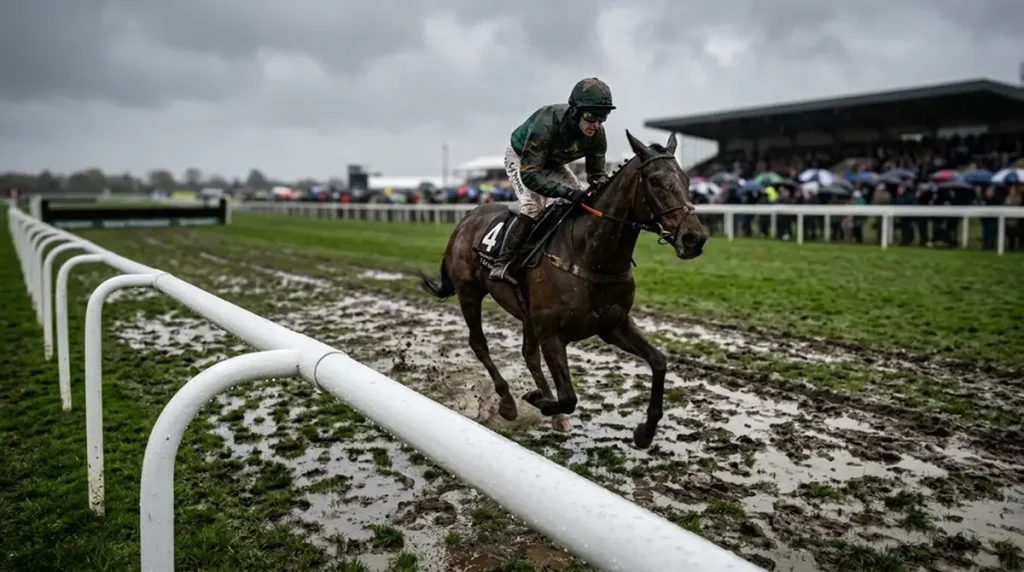
html
Contents
The 78% number that changed everything
If you’d told me in 2022 that within three years three-quarters of British fixtures would be running on soft or heavy ground, I’d have laughed. Soft and heavy ground used to be a winter feature – a few weeks in November and February when the all-weather tracks did the heavy lifting and turf scheduling worked around the worst weeks. The three-year average for soft-or-heavy fixtures sat at around 48%. Then 2026 was wet. 2026 was wetter. And by the end of Q1 2026 the figure had jumped to 78% – a structural shift in British turf conditions that has rewired the Trifecta variance distribution for any punter paying attention.
Going isn’t just about which horses can handle the conditions. It’s about the speed of the race, the spread of finishing positions, the survival rate in jumps races, the strength of late-running closers, and the predictability of the 1-2-3 across the line. Heavy ground compresses some of those distributions and stretches others, and the net effect on Trifecta dividends has been an upward shift in average payout combined with a meaningful increase in variance. This piece walks through the 78% number and what it has meant in practice for serious pool punters across 2026.
The 78% in context
Q1 2026 saw 78% of British turf fixtures running on soft or heavy ground, against the three-year average of around 48%. That’s not a 30-percentage-point statistical hiccup – that’s a fundamental redistribution of running conditions, driven by sustained wet weather across late 2026 and early 2026 that left tracks unable to recover between meetings. The trend continued through the spring and into the early summer, with relief only arriving in late June and a partial dry-out across July and August.
The practical effect on Trifecta selection was immediate. Form profiles built on good ground became unreliable as predictors. Horses whose recent runs had been on testing ground – even if those runs hadn’t been winning runs – outperformed their starting prices because the conditions kept favouring exactly the kind of grinding stayer that thrives in soft. The pool dividends shifted with the form. Average UK Trifecta dividends across Q1 2026 ran modestly above the longer-run average of £153 per £1 unit, with the variance lifting sharply on cards where the going caught the public by surprise.
What heavy and soft ground do to race shape
Heavy ground does three measurable things to a race. It slows the early gallop, because horses can’t sustain quick fractions through deep going. It stretches the field, because the gap between front-runners and closers widens as the closers struggle to find traction in the back half. And it punishes turn-of-foot, because acceleration in the final furlong requires solid ground under the hoof and heavy ground doesn’t provide it. The 1-2-3 across the line on heavy ground therefore concentrates around prominent racers and front-end horses who don’t need to find a kick, and away from hold-up types who rely on a sprint finish.
Soft ground is a milder version of the same pattern. The front end gets less of a kicking, the finish stretches less dramatically, and the form book remains more reliable. But the directional bias – towards prominent and front-end runners, away from turn-of-foot closers – is the same. Stable Trifecta pool dividends on heavy ground therefore favour combinations weighted towards the front of the race, and the public’s tendency to back the classier horses regardless of ground produces a regular asymmetric edge for punters who adjust their selection profile to the conditions.
I’ve kept a running adjustment in my Trifecta selection process since Q4 2026 – every race on soft or heavy ground gets at least two of three picks weighted towards prominent or front-end running styles, with a turn-of-foot closer relegated to the third placing if included at all. The discipline has lifted my hit-rate on heavy-ground Trifectas materially and pulled the average dividend slightly down – which is the trade-off you accept when you tighten the selection profile around predictable race shapes.
The all-weather as a counterweight
All-weather tracks operate as a relief valve during the heavy turf period – consistent fibresand or polytrack surfaces that don’t deteriorate the way turf does, with race shapes that remain stable across cards regardless of the weather. The 8.83-runner average for flat racing in H1 2026 was inflated by the all-weather contribution; all-weather fields tend to run slightly larger and more consistently than the turf equivalent, and the predictability of the surface keeps the Trifecta dividend distribution closer to the long-run average.
The strategic value of the all-weather during heavy-ground turf seasons is twofold. First, it provides a baseline of stable Trifecta opportunities where the going variable is fixed and the race shape depends only on the runners, the pace map, and the form. Second, it allows you to maintain selection discipline through the season without being forced to bet exclusively into the high-variance heavy-ground turf cards. My approach across Q1 2026 was to lean more heavily on Wolverhampton, Lingfield, Kempton, and Newcastle all-weather fixtures than I would in a normal year, treating them as the controlled-variance portion of the calendar.
The all-weather Trifecta pools are typically thinner than the major-meeting turf equivalents – smaller crowds, lower-profile racing, less recreational money – but the dividend predictability and the consistent race shape make them a useful structural balance against the heavy-ground turf volatility. The longer-run Trifecta-beats-Tricast 80% figure draws on a sample that includes both, and the all-weather sample contributes the steadier portion of the outperformance distribution.
Slip adjustments for the soft-and-heavy season
The adjustments I make to Trifecta slips during a prolonged soft-and-heavy period come down to four practical changes. First, the banker leg gets a stricter test for proven ground preference. A horse with three runs on good ground and no soft-ground form simply doesn’t qualify as a banker on testing ground, regardless of his recent figures. Second, the structural anchors lean towards prominent and front-end runners by at least 60% of the selection weighting. Third, the value runners – the longshots covered for third – get filtered for stamina rather than turn-of-foot, because the late-furlong sprint that delivers closers on good ground rarely materialises on heavy.
The fourth adjustment is around staking. Heavy-ground Trifecta dividends have higher variance than good-ground equivalents, which means individual ticket sizing should fall slightly to maintain bankroll discipline across a longer expected losing streak. The £4.4m uplift to Levy yield projected for 2026 doesn’t reach the punter directly, and risk-based affordability checks at the £150 net deposit trigger threshold mean that intrusive operational reviews can hit a punter sustaining moderate losses across a wet weekend even when the long-run expected value remains positive. Sizing has to absorb both the dividend variance and the regulatory friction.
For the wider context of how pool, bankroll, and selection discipline interact when conditions are unstable, the breakdown of structured Trifecta tickets around bankers and key positions covers the selection-side maths that supports these adjustments.
Soft and heavy as the new baseline
If 78% of British fixtures running soft-or-heavy through Q1 2026 was a freak data point, you could write it off and move on. The wet conditions across late 2026 and 2026 suggest it isn’t a freak – it’s the new baseline, or close to it. Turf racing in Britain is increasingly run on ground that doesn’t favour the form-book favourite, doesn’t reward turn-of-foot, and doesn’t produce the 1-2-3 outcomes that twenty years of historical data would predict. The Trifecta punter who adapts – by tightening selection profiles, leaning into prominent racers, accepting moderately higher variance, and using the all-weather as a counterweight – has access to a structural edge the public mostly hasn’t priced in. The punter who keeps betting good-ground form on heavy-ground cards is the punter funding the rest of us.
