
Tote Trifecta on Jumps Versus Flat – Strategy Differences That Matter
 Available in US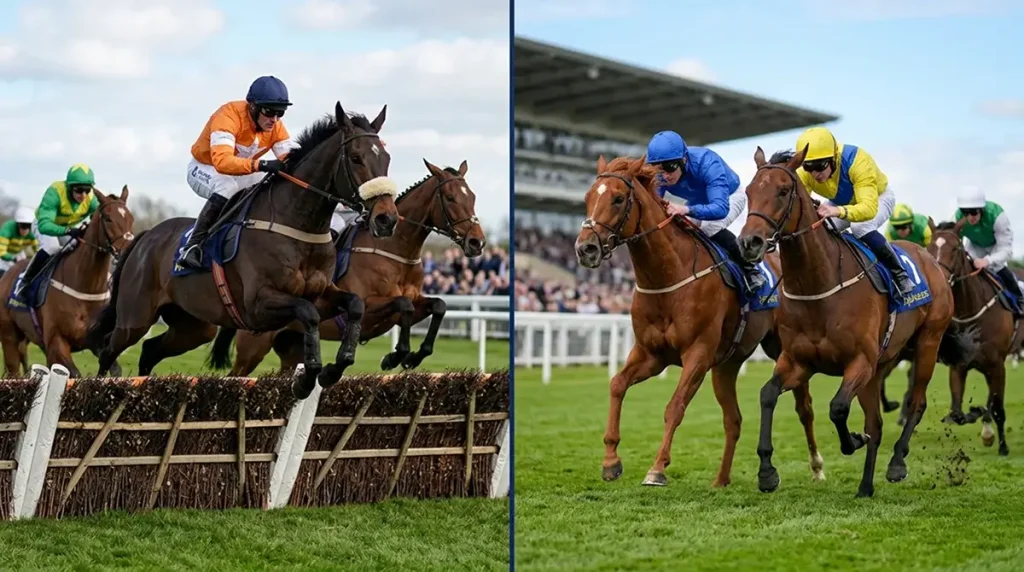
html
Contents
Two codes, two different bets
The single most expensive mistake I made in my first year of serious Trifecta betting was treating jumps races and flat races as the same product through the same window. A Trifecta is a Trifecta, I told myself. Three horses across the line, settle the pool, collect or move on. I lost a lot of money that year and most of the lost money was on jumps cards where the bets I’d built were structurally wrong for the discipline.
Jumps and flat are two different sports for Trifecta purposes. The pool architecture is the same – same 25% UK Tote pool deduction, same 10p Tote unit, same £2 minimum bet, same redistribution mechanics – but the underlying race dynamics are fundamentally different, and what works on one code breaks on the other. Flat racing is decided by ability, speed, and tactical positioning. Jumps racing is decided by ability, jumping technique, stamina, and the constant risk that a horse will simply not complete the race. Building a Trifecta around the wrong assumptions is the difference between a profitable approach to one code and a leaking bankroll on the other.
This piece walks through how I treat the two codes separately, the structural differences in field profile and risk, and the practical rules I use to build Trifectas on each.
The flat pool profile
Flat racing’s H1 2026 average of 8.83 runners per race produced larger fields than the H1 2026 jumps figure of 7.83 – about 13% more declared runners per race on average. Q3 2026 narrowed that gap slightly, with Core Flat at 8.54 against Core Jumps at 7.63, but the structural pattern holds. Flat racing offers larger fields, deeper Tote pools, and a wider combinatorial range for Trifecta combinations to settle through.
Flat races also have far less in-race volatility. A flat horse rarely fails to complete the race – falls and unseated riders are vanishingly rare in flat racing, withdrawals at the start can happen but most non-completions involve a horse easing through the line out of contention rather than dropping out entirely. The 1-2-3 across the line therefore reflects the same set of runners that left the gates, with the only real disruption coming from the rare occurrence of a horse being pulled up or stopped mid-race.
Flat Trifecta selection is therefore an exercise in form, speed, draw, jockey, and ground. The same factors that produce a flat winner produce a flat second and third, with the placings ordered by the relative quality of each runner under those conditions. Combine pace mapping with class-and-rating analysis and the resulting Trifecta shape is close to what you predicted, race after race.
The jumps pool profile
Jumps racing introduces a category of risk that doesn’t exist on the flat – non-completion. A horse can refuse at a fence, fall, unseat its jockey, be brought down by another faller, or pull up exhausted before the finish. Each of those outcomes removes a runner from the field mid-race, often unexpectedly, and produces 1-2-3 combinations that no form-based pre-race analysis could reasonably have predicted. The Trifecta dividend on those races can be enormous – the 1,011-race study showing the Tote Trifecta beats the Tricast 80% of the time with an average 26% outperformance draws a meaningful chunk of its sample-wide profit from exactly these unpredictable jumps results.
The smaller field sizes – 7.63 in Q3 2026 Core Jumps – limit the combinatorial possibilities. Six possible 1-2-3 combinations on a five-horse race is 60 different orderings; eight runners produces 336 possible Trifecta combinations. Compared with a 16-runner flat handicap producing 3,360 combinations, the jumps pool is concentrated in a much smaller permutation space, which on its own pushes dividends down. The countervailing factor is the non-completion risk, which produces 1-2-3 combinations that would have been deemed impossible pre-race and which therefore carry minimal ticket coverage in the pool.
The result is a different shape of dividend distribution. Jumps Trifectas pay smaller dividends on average than flat Trifectas on equivalent field sizes, but produce far larger right-tail outliers when non-completion reshapes the race. The Cheltenham Festival 2026 saw all 28 races finish in the top 31 by turnover in British jumps racing, and the Trifecta dividends from those four days included several four-figure outcomes driven by exactly this dynamic.
The non-completion risk in practical terms
Non-completion changes Trifecta strategy in two specific ways. The first is that your structural anchors need to include at least one runner who might benefit from chaos. On a three-mile chase with twelve runners and ten fences, the average completion rate per runner is somewhere between 65% and 80%, depending on race quality and going. That means in a typical such race, two to four runners won’t finish. The Trifecta payout therefore goes to combinations that include horses who might not have been front-of-mind pre-race but who completed cleanly when others didn’t.
The second is that banker bets carry materially higher structural risk on jumps. A flat banker either runs his race or he doesn’t, with a fairly small probability of “doesn’t” outside form, fitness, or pace failure. A jumps banker can hit the floor at the second fence and end the bet before the race is properly underway. The probability of a clean round must enter the banker’s expected-value calculation. For a horse with a good jumping record on a track he’s run well at, that probability might be 90%-plus. For an iffy jumper or a horse new to the track, it can drop to 70% or lower, and the banker structure ceases to be defensible.
Heavy going compounds the non-completion risk on jumps. With 78% of Q1 2026 fixtures running soft or heavy ground, jumps races on testing ground produce both more tiredness-induced pull-ups and more jumping errors at the late fences. Soft-ground three-milers in particular reward stayers who complete tidily over runners who might be classier but lose composure when fatigued.
The practical rules I use for each code
On flat Trifectas I bet larger fields, build banker structures around runners with strong form-fit, weight pace mapping heavily, and accept that the dividend distribution is narrower and more predictable than the jumps equivalent. Twelve-plus runners is the minimum field size I’d consider for a serious Trifecta stake on flat – below that, the combinatorial cost of meaningful coverage rises and the pool dividend rarely justifies the spend.
On jumps Trifectas I bet smaller fields but apply a non-completion buffer in the anchors. Banker bets on jumps have to clear a stricter test for jumping reliability and ground preference, not just form-fit. I include at least one structural anchor who’s a strong stayer rather than the classier horse, because stayers complete cleaner finishes when the pace lifts in the final mile. And I size jumps Trifectas slightly smaller than the flat equivalent on the same bankroll, on the basis that the right-tail upside compensates for the increased non-completion variance.
One rule applies to both codes – the 8-declared and 6-starter minimum for Tricast settlement at fixed-odds doesn’t apply to the Tote Trifecta, which means small-field races where the bookmaker won’t price a Tricast can still host a Trifecta pool. Whether the dividend is worth chasing in those small-field races depends on the same field-and-pool calculus that governs every Trifecta bet, but the option is structurally available.
For the combinatorial mechanics that underpin banker, box, and key Trifecta structures across both codes, the detailed breakdown of how UK Trifecta tickets are structured covers the maths in full.
The right bet for the right code
Treating jumps and flat as separate products is the foundation of any serious approach to the Tote Trifecta in British racing. Flat racing rewards careful form analysis, pace mapping, and disciplined banker structures on big fields. Jumps racing rewards stayer-friendly anchor selection, non-completion-aware banker tests, and a willingness to accept that the race will sometimes reshape itself in ways no pre-race analysis could predict. Both codes pay. Both codes lose. The mistake is using the same architecture for both and hoping the variance will work itself out across a season. It won’t. The seasons in which I treated the codes separately have outperformed every season in which I didn’t, and the gap isn’t small.
