
The 10p Unit and the £2 Minimum: UK Tote Trifecta Staking Rules
 Available in US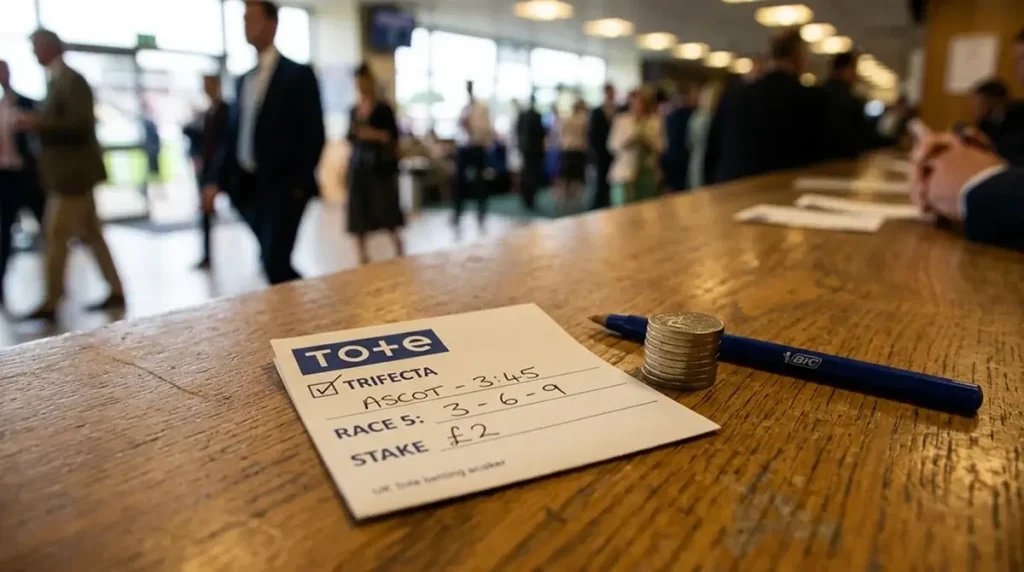
html
Contents
Why the Tote Sells Trifectas in 10p Slices
The single most common question I get from newer punters at the Tote is some version of “what is the smallest Trifecta I can actually place?” and the answer is never as simple as the question. There are two different floors on a UK Tote Trifecta – the unit and the minimum bet – and confusing them is how punters end up either staking far more than they intended or having a slip refused at the till.
The unit is 10p. The minimum bet placement is £2. Both rules sit underneath every Trifecta slip placed in Britain, online or on-course, and they interact in a way that decides what your slip actually costs. Get this right and your bankroll behaves predictably. Get it wrong and you discover, halfway through a Saturday afternoon, that the “small” Trifecta box you placed an hour ago has actually cost five times what you thought.
The Difference Between a Unit and a Stake
Think of the unit as the dividend currency and the stake as the price of admission. A Tote Trifecta dividend is always published per unit. If the dividend reads £180.50, that is the payout on a £1 unit Trifecta line. A 10p unit on the same line pays one-tenth of that – £18.05. A £2 unit pays double – £361.00. The unit you choose decides the proportion of the dividend that lands in your pocket.
The stake is the total amount you actually pay to place the slip. Stake equals unit multiplied by number of lines. A 4-horse Trifecta box at the £1 unit runs 24 lines and costs £24. The same 4-horse box at the 10p unit runs the same 24 lines but costs £2.40. Same coverage of the field, one-tenth of the stake, one-tenth of the dividend.
Where punters get hurt is the £2 minimum bet rule. Even if your unit calculation comes out below £2 – a 3-horse box at 10p costs 60p in line theory – the Tote enforces a £2 minimum on the total slip. If your unit-by-line maths comes out below £2, the system either rejects the slip or, on some channels, rounds up the unit to clear the £2 floor. Either way, what you intended to stake and what you actually staked are different numbers.
The clean way to think about it is in three layers. The 10p unit is the resolution at which the Tote will accept your money. The total stake – unit times lines – has to clear £2 to be a valid bet. The dividend is always published at the £1 unit so you can scale up or down to your actual unit by multiplying or dividing.
What a Tote Slip Actually Captures
The slip itself is the formal contract between you and the Tote. Every Trifecta slip carries five pieces of information that determine settlement – the race meeting, the race number, the bet type, the selections, and the unit-by-lines architecture.
The bet type is what locks you into the Trifecta product specifically, as opposed to an Exacta or a Tricast. On the Tote, Trifecta is one of several pool products and the slip designates which pool your money enters. A Trifecta slip cannot be back-converted to an Exacta after the off, even if your selections happen to match a winning Exacta line. The slip is the bet.
The selections are the horses by name or number on the racecard. A Box Trifecta lists every selection in one block, with the understanding that every permutation of three among those selections counts as a separate line. A Key Trifecta – sometimes called a Banker – designates one or two specific selections as anchors, with the remaining selections filling the other slots in permuted order. A Permed Trifecta allows the punter to nominate exactly which lines they want to back, omitting permutations they do not believe in.
The unit-by-lines architecture is what the slip uses to calculate the stake. On a Box Trifecta of four horses at the £1 unit, the slip captures 24 lines at £1 each, total £24. On the same four horses at the 10p unit, the slip captures 24 lines at 10p each, total £2.40. The slip’s record of the unit determines the dividend payout if you win, and you cannot change it after the off.
Where the 10p Unit Becomes Tactically Useful
I want to be honest about when the 10p unit earns its place and when it does not. The 10p unit is the right call on three specific situations, and the wrong call on most others.
The first situation is wider-than-usual field coverage with strong opinion across all selections. If you have done the work to identify five horses you genuinely believe can place in a 16-runner handicap, the £1 unit box of those five runs 60 lines at £60. The 10p unit takes that to £6, which is well below the £2 minimum so the system snaps it back to roughly £6 in any case. The 10p unit lets you cover the full architecture without overcommitting your bankroll on a single race. If the result lands one of your 60 lines, the dividend per 10p unit is one-tenth of the published dividend – modest in absolute terms, but profitable relative to the stake.
The second situation is high-variance races with weak conviction. Maiden two-year-old contests, the Coventry Stakes pattern I covered separately on this site, and similarly form-light races where the casual money builds the pool to genuinely silly depths. A 10p unit Trifecta box on a maiden race at Royal Ascot lets you take a flier on the chaos for a fraction of the stake you would risk on a handicap where you have a real opinion.
The third situation is the multi-race accumulator-style strategy where you place small Trifectas on every race of a card. The cumulative stake matters and the 10p unit lets you run the full programme without the bankroll dying on the first three races. I do not personally play this strategy because it has poor expected value across the card, but it has its defenders and the 10p unit makes it operationally possible.
Where the 10p unit is the wrong call is on a tight 3- or 4-horse Trifecta with real conviction. At those line counts the £1 unit produces a stake of £6 to £24 – entirely reasonable for a serious slip – and the £1 unit dividend is ten times the 10p dividend. Cutting the unit to 10p on a high-conviction slip is leaving money on the table. The 10p unit is the right tool for wide coverage, not for sharp selection.
Online vs On-Course Trifecta Stakes
The same 10p unit and £2 minimum apply across both channels, but the user experience differs in two ways worth knowing before you switch from on-course to an online Tote app.
On-course, the till operator can see your slip, ask whether you intended the £1 unit or the 10p unit, and catch the £2 minimum violation before the bet goes through. The slip is also handled physically, which means the audit trail for non-runners and Rule 4 adjustments is visible in real time. The downside is queueing in the last five minutes before the off, which costs you the chance to react to late-market moves.
Online, the slip-builder calculates the total stake automatically as you toggle the unit and add selections. If you set the unit to 10p on a 3-horse box, the system will alert you that the total stake of 60p falls below the £2 minimum and either require you to raise the unit or add a selection. The audit trail for non-runners is handled by the operator’s settlement engine, with the refund or Rule 4 deduction shown in your account history after the race. The downside is no human catch on a misreading – if you mean to back six horses and accidentally click seven, the slip stands.
For the actual maths of how a unit-stake translates into dividend per line – including the per-unit interaction with non-runner refunds, which is where most punters trip up – the longer walkthrough sits in our UK Trifecta payout calculator guide. The unit rules and the dividend calculation rules are two halves of the same arithmetic, and reading them together is what stops the punter from being surprised by what their slip actually pays.
