
Reading a UK Race-Card for the Trifecta – A Practical Method
 Available in US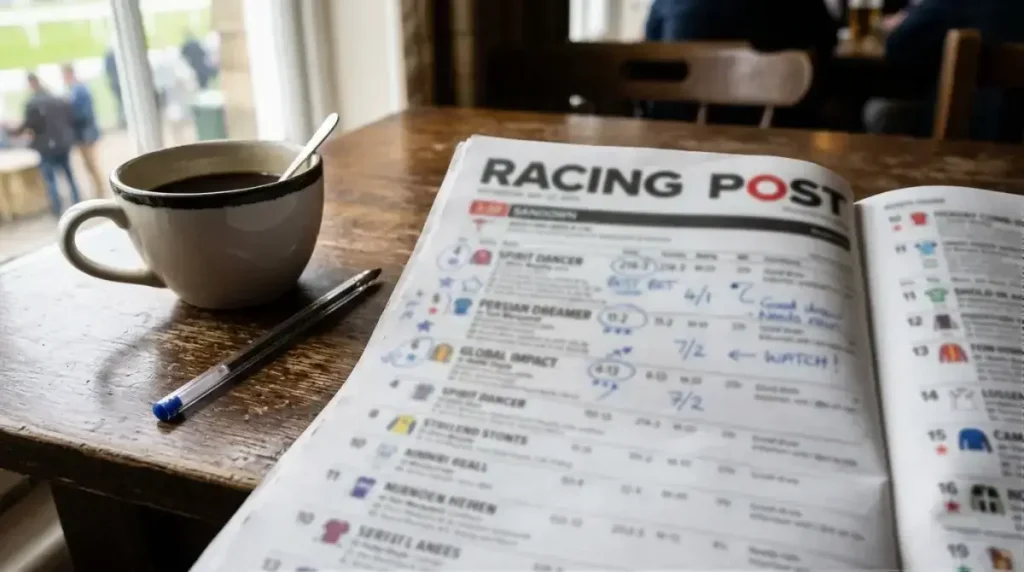
html
Contents
What the card is actually trying to tell you
I taught a new punter to read a race-card last summer. He’d been betting for six months on horse-name and jockey alone, with a polite habit of asking my opinion before each race and a private suspicion that the rest of the information on the page existed only to make him feel intimidated. Two afternoons of working through the same card together, line by line, and his expression shifted from politeness to actual interest. The card isn’t a defensive wall of jargon. It’s a structured summary of every variable that matters for predicting where the horses will finish, laid out in a format that has barely changed in eighty years because the format works.
For the Trifecta in particular, the race-card is the primary input. Pace mapping, form-fit, class, jockey arrangement, draw – every selection decision rests on information that’s printed on the card and confirmed by the trainer reports, the going stick, and the on-day market move. This piece walks through how I read a card with Trifecta selection in mind, in the order I actually read it.
Class and rating come first
Before I look at any individual runner, I look at the race header. Class is the overall standard of the race – Class 1 down to Class 7 – with each class containing further gradations (Group 1, Listed, Conditions, handicap bands within Class 3 and below). The class tells you how the field has been assembled: a Class 2 handicap restricts entries to horses rated within a defined band, typically 86-105, so every runner sits within twenty pounds of the others on the official rating scale. A Class 5 handicap covers ratings of 56-70, with similar internal compression but at a much lower performance ceiling.
The rating spread matters enormously for Trifecta selection. A handicap with a narrow rating band – twenty runners all rated within ten pounds – is a structurally competitive race where any of twelve to fifteen could plausibly fill the top three. A handicap with a wider effective spread – top weight at 105 carrying twelve pounds more than bottom weight at 88 – concentrates the win and place probabilities towards the higher-rated end of the field, with the longshots filling the third placing more often than the second or first. The 1,011-race study showing the Tote Trifecta beats the Tricast 80% of the time draws much of its outperformance from exactly these wider-spread handicaps where the public’s pricing of the third placing systematically underweights longshots.
For non-handicap races – Group races, Listed races, conditions stakes – class still matters but rating spreads less obviously. Group races attract the genuine top-class horses, with the field separated by ability rather than handicap rating, and Trifecta dividends tend to be smaller because the win-place probabilities concentrate sharply.
Form figures and what they actually show
The form figures next to each runner – a string of digits like 4-2P11 or 5-37/4 – are a compressed history of recent finishing positions, with letters indicating non-finishes (P for pulled up, F for fall, U for unseated, R for refused) and slashes or dashes marking season breaks. Reading the figures fluently is the next step up from horse-name betting and it’s the step that separates casual from serious form analysis.
What I’m looking for in the form figures is pattern rather than headline. A horse showing 1-1-1 on the figures has won three on the bounce – impressive at first glance, but the question is whether the three wins came at the same class as today’s race. A horse showing 4-3-2 has been improving steadily without quite getting there, often a stronger Trifecta inclusion than the winner-of-three because the pattern is moving in the right direction at the right time. A horse showing P-F-U recently has had a torrid run for whatever reason, and the figures tell you that the recent form profile is unsettled even if the underlying ability is intact.
Non-completion patterns matter especially on jumps. The Q3 2026 Core Jumps average of 7.63 runners per race means non-completion rates have a direct effect on Trifecta settlement, with several horses falling, refusing, or being pulled up in a typical chase. A runner whose form figures contain repeated non-completions over fences is structurally riskier as a Trifecta inclusion than the same runner’s class would otherwise suggest.
Jockey, trainer, and the partnerships that signal intent
The jockey and trainer line is the third reading-priority on the card. Top jockeys ride the strongest book of mounts and tend to be booked on horses with realistic claims rather than no-hope outsiders – the appearance of a leading jockey in the saddle on an outsider is itself a signal that the connections believe the horse has a chance. The reverse signal – an apprentice or claiming jockey on a runner who’d normally attract a top-tier rider – tells you the connections aren’t expecting a big run, or the engagement was made for tactical reasons unrelated to expected performance.
The trainer angle works at a slower timescale. Trainers send horses to specific tracks for specific reasons. A trainer based in Lambourn sending a runner to Newcastle has made a journey that costs money and time, and the choice typically reflects a genuine view that the horse is well-placed at that meeting. The same trainer sending a runner to an obvious local meeting is exercising convenience rather than placement strategy. The trainer-trip signal is harder to read than the jockey signal but worth tracking on longer odds, where the difference between a horse trained-for-the-day and a horse running on routine can be the difference between a Trifecta third placing and a tailed-off finish.
Cheltenham Festival 2026 produced a £4.93m prize fund across 28 races, with all 28 finishing in the top 31 by turnover in British jumps racing. The concentration of top-tier connections at the Festival means jockey-trainer signals run at maximum intensity for those four days, and reading the partnership intent on each runner is one of the highest-leverage activities a Trifecta punter can do across the year.
The card method in practice
My working method for reading a card with a Trifecta in mind takes about fifteen minutes per race. I start by checking the class and rating header to establish what kind of race I’m looking at and what spread of ability is in the field. I then go runner by runner, noting the form figures with attention to recent trajectory rather than headline figures, the running style suggested by the figures and the trainer commentary, the jockey arrangement and any change from the runner’s previous engagement, and the draw position (on flat) or fence record (on jumps) where directly relevant.
That’s the first pass. The second pass overlays the going – Q1 2026 saw 78% of British turf fixtures running soft or heavy, and the going filter eliminates roughly a third of any field on testing ground because the horses without proven preference for the conditions become structurally unlikely to fill a top-three placing. The third pass is the pace map – labelling each remaining runner as leader, prominent, mid-division, or hold-up to determine the predicted race shape.
By the end of the three passes I have a field reduced from twenty declared to perhaps eight realistic Trifecta candidates, with a clear sense of which one or two could anchor a banker structure and which three to four would fill the supporting roles. The ticket-cost discipline kicks in next – at the 10p Tote unit with a £2 minimum bet, a five-anchor banker-to-win ticket costs £2 and a four-horse box costs £2.40, so the structure has to match conviction rather than spread thinness across more lines. For the deeper architecture of how the ticket structures compare in maths and expected return, the breakdown of UK Trifecta box, key, and banker structures walks through the comparative work in detail.
The card as the punter’s working document
The race-card isn’t a wall of jargon, and the punters who treat it as one are the punters whose Trifectas keep losing. It’s a structured working document designed to compress every variable that matters into a format you can read in fifteen minutes if you know what you’re looking for. Read it properly – class header first, form figures with attention to trajectory, jockey-trainer intent signals, going and pace overlays – and the race reduces from twenty declared runners to a manageable shortlist with a defensible Trifecta structure on top. Skip the work and you’re betting names, which is fine for the Grand National and a disaster for everything else. The card is the bet. Treat it that way.
