
The Trifecta Around the World – Tricast, Tiercé, and What the Same Bet Is Called Abroad
 Available in US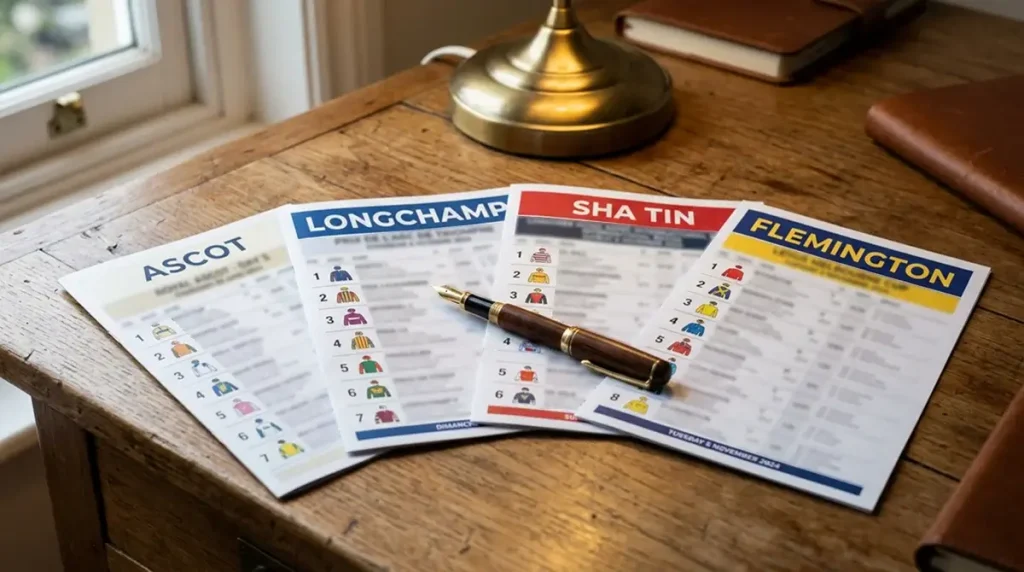
html
Contents
A bet by any other name
I was at the PMU window at Longchamp a few years ago trying to back the Trifecta in the third race. The clerk looked at me blankly until a fellow punter behind me leaned in and said the word “Tiercé”. The clerk’s face lit up, the bet went on, and I learned that a Trifecta in France isn’t a Trifecta – it’s a Tiercé, and the rules around it are slightly different to the British equivalent. The same fundamental bet, three placings in correct order, dressed in different terminology and settled through different pool architecture depending on where you happen to be standing.
For a British punter, the international landscape of Trifecta-style bets matters more than it used to. World Pool 2022 saw 17 days of British and Irish racing run with stakes commingled across global jurisdictions, with £541m in total stake routed through the merged pools. A British punter betting at Royal Ascot 2026 is now functionally betting into the same pool as a Hong Kong punter, a French punter, and an Australian punter – except each of those punters is calling the bet something different, settling it under slightly different rules, and bringing different cultural expectations to the third placing.
This piece sets out the terminology, the rule variations, and the structural differences across the major jurisdictions, with practical notes on which differences matter when you’re betting through them.
The UK terminology
In Britain, two products dominate. The Tote Trifecta is the pool-based bet, settled by redistributing the pool across winning tickets after a 25% deduction, with the dividend published on a £1 unit basis and the minimum stake set at £2 to a 10p Tote unit. The Tricast is the fixed-odds equivalent, sold by bookmakers at a quoted price derived from a Computer Straight Forecast-style formula extended to three placings, with the 8-declared 6-starter minimum required before the bet is offered.
The 1,011-race study comparing the two products at the same races showed the Tote Trifecta beats the Tricast 80% of the time, with the average outperformance running at around 26%. The two bets are conceptually identical – three horses, correct order, win or lose – but the settlement architectures produce systematically different dividend profiles, and the British punter has access to both at the same window for the same race.
The UK Trifecta’s average dividend of around £153 per £1 unit is meaningfully higher than the Irish Tote Trifecta equivalent, with the British average running roughly 24% above the Irish equivalent. The architectural reasons sit in the pool depth, the field-size profile, and the commingling effects from World Pool fixtures.
France and the Tiercé
The Tiercé is the French Tote-style bet on three placings in correct order. The product runs through the PMU – the Pari Mutuel Urbain monopoly that operates French pool betting – with dividends settled in the same redistribution model as the British Tote, though with a different takeout rate and a different minimum-stake structure. The Tiercé pools concentrate heavily on a small number of designated Tiercé races each weekend, typically broadcast across France with substantial public attention, which produces deep pools and dividends that can rival the British heritage-handicap equivalents.
The structural quirk that British punters need to know is that the PMU offers multiple variants – the straight Tiercé requires correct order, but the PMU also offers a “dans le désordre” version where the bet pays at a reduced dividend if your three horses finish 1-2-3 in any order. That’s effectively the French Trifecta box rolled into the same product line. The straight-order ticket and the any-order ticket compete for the same combinations but settle at different prices, with the any-order paying typically a quarter to a fifth of the straight equivalent.
The French Tiercé is therefore not the same product as the British Tricast – the names share Latin roots, but the Tiercé is a pool bet and the Tricast is a fixed-odds bet. The closer functional equivalent to the British Tricast in France is the bookmaker-priced trio offered by the small handful of operators that compete with the PMU on non-Tiercé races.
Hong Kong and the Tierce
The Hong Kong Jockey Club operates the Tierce – note the lack of accent in the romanised name – as a Tote-style three-placing bet across the Hong Kong racing calendar. Hong Kong has historically been the most technologically advanced pool-betting jurisdiction in the world, with commingled pool architecture, deep daily liquidity, and a betting public that treats the Tierce as a routine staple rather than an exotic side bet. The pool depth on a typical Sunday at Sha Tin dwarfs anything available on a midweek British card.
The Tierce was the model that informed the World Pool architecture extended to British racing from 2020 onwards. The Jockey Club’s technology integrated British and Irish Tote pools into the global commingling framework, with the £541m staked across 17 World Pool days in 2022 representing the early-stage demonstration that the model scaled to British conditions. Betting a Trifecta on a Royal Ascot World Pool fixture is, in operational terms, betting into a pool that the Hong Kong Jockey Club has architected – even though the British punter sees only the Tote Trifecta interface.
The Hong Kong Tierce includes both straight-order and any-order variants, with the straight version paying substantially higher dividends. The pool-deduction rate differs from the British 25%, with Hong Kong applying a somewhat lower takeout that reflects the higher turnover volumes and the greater commercial scale of the jockey-club operation.
Canada, Australia, and the Trifecta name
Canadian and Australian racing both use the term “Trifecta” for the three-placing pool bet – making them the closest direct equivalents to the British product in name as well as in function. The Australian Trifecta runs through the Tote operators across each state, with state-by-state architecture historically fragmented but now substantially commingled into the national pool. The minimum stake structure, the pool deduction rate, and the dividend publication conventions all differ slightly from the British equivalents.
Canada operates the Trifecta primarily through Woodbine Entertainment Group and the regional Tote networks, with thinner pool liquidity than the Australian or British equivalents but with consistent operational rules that match international standards. Major Canadian fixtures – the Queen’s Plate, the Woodbine Mile – sit on the international racing calendar and increasingly attract commingled stake flow, though Canadian racing has not yet been integrated into the World Pool architecture at the depth that British and Irish racing has.
The shared “Trifecta” name across the UK, Australia, Canada, and several smaller jurisdictions reflects a common origin in Anglo-Saxon Tote architecture. The French Tiercé and Hong Kong Tierce sit in a parallel tradition with Romance-language naming conventions. For a punter moving between jurisdictions, the practical advice is to confirm three things at every new window – minimum stake, pool deduction rate, and whether the bet on the slip is straight-order or any-order. The other details mostly follow.
For the wider context of how commingled global pool architecture has shaped the British Trifecta product in 2026, the detailed treatment of Tote+ and World Pool mechanics for UK Trifecta punters traces the international architecture into its British implementation.
One bet, many windows
The Trifecta in its various international forms is the same bet wearing different uniforms. Three placings, correct order, settled through pool or fixed-odds architecture depending on the jurisdiction, with terminology that shifts across borders but mechanics that converge on the same fundamental product. For the British punter, the practical value of knowing the international landscape is that World Pool fixtures route British stakes into pools that include international tickets from punters using different terminology and different cultural expectations of the third placing – and those punters’ biases create the asymmetries that British punters with disciplined selection can exploit. The naming is incidental. The architecture is the bet.
